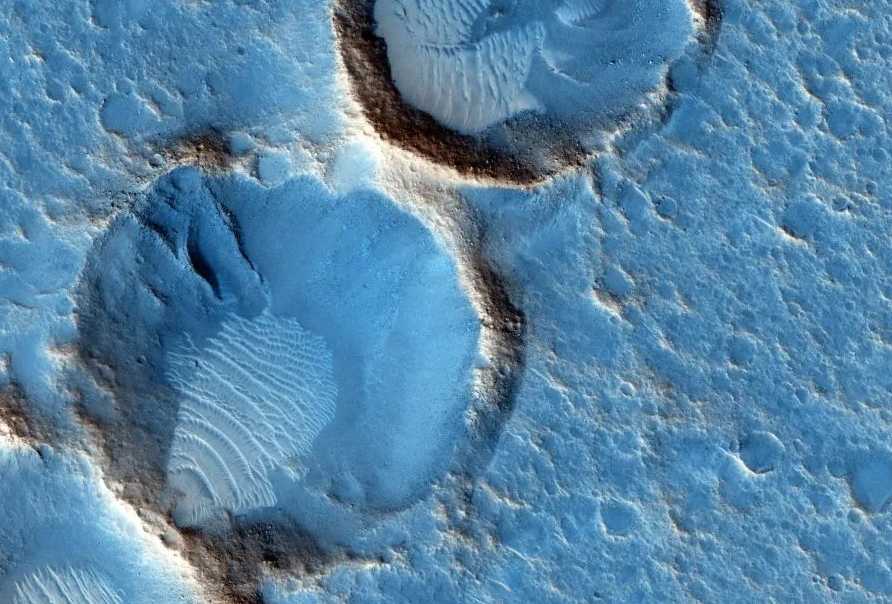
Weir’s novel places astronaut Mark Watney’s stranded mission at "Ares 3," whose fictional coordinates align with the cropped HiRISE scene. Watney’s 6-meter-diameter habitat module would measure just one-tenth the width of the largest crater in this image—a humbling scale comparison. Intriguingly, the imagined Ares 3 site lies ~800 km from the real-world Carl Sagan Memorial Station, where NASA’s 1997 Pathfinder lander touched down, bridging fiction and scientific history.
The landscape tells a story of cosmic collisions and wind-driven erosion:
- Impact Craters: Ranging from fresh, sharp-rimmed craters to ancient, degraded basins, these scars record billions of years of asteroid strikes.
- Dune Fields: Sinuous dark ridges are barchan dunes, shaped by prevailing winds that sweep iron-rich dust across the plains.
- Layered Deposits: Subtle color variations hint at sedimentary layers, possibly formed by ancient water or volcanic activity.
HiRISE’s 0.3-meter/pixel resolution reveals features as small as a picnic table, allowing scientists to study Martian geology in unprecedented detail.
The Pathfinder mission, which deployed the rover Sojourner, predated The Martian by two decades but shares thematic ties: both explore human resilience on Mars. Watney’s reliance on botanical ingenuity mirrors real-life plans for Martian agriculture, while the Ares 3 site’s proximity to actual landing zones highlights the scientific plausibility Weir infused into his story.
"Astronauts may one day walk where Watney ‘survived,’" says Dr. Alfred McEwen, HiRISE principal investigator. "HiRISE data helps mission planners identify safe landing zones and resources like subsurface ice—just as The Martian imagined."
HiRISE’s blue-tinted images serve a scientific purpose, not artistic license:
- False Color Processing: Infrared and visible light bands are combined to distinguish minerals—blue might represent basaltic rocks, while red signals iron oxides.
- True Color vs. Perception: Mars’ iconic red hue comes from iron oxide (rust) in surface dust, but large-scale landscapes often appear tan or gray under the planet’s thin, dusty atmosphere.
As humanity prepares for crewed Mars missions, images like this bridge the gap between scientific data and popular imagination—reminding us that the line between a fictional astronaut’s survival story and real-life exploration is as thin as Mars’ atmosphere, yet as profound as the Red Planet itself.