Econ Vortex

JWST Captures Stunning Portrait of Dying Wolf-Rayet Star WR-124 in Cosmic Farewell
1 minute read
JWST Captures Stunning Portrait of Dying Wolf-Rayet Star WR-124 in Cosmic Farewell
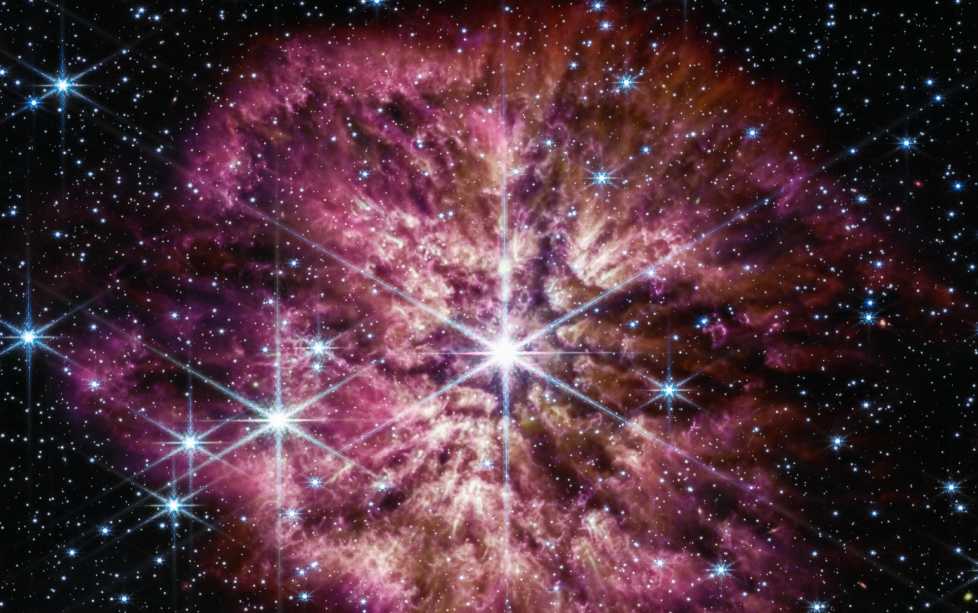
A breathtaking image from the James Webb Space Telescope (JWST) reveals Wolf-Rayet star WR-124, a 30-solar-mass behemoth 15,000 light-years away in Sagittarius. First observed in June 2022, the star has ejected 10 solar masses of gas and dust, forming a spectacular nebula—an unprecedented view of a star in its final, violent stages before a potential supernova.

A Cosmic Prelude to Stellar Explosion

WR-124 is in the Wolf-Rayet phase, where massive stars shed their outer layers at thousands of km/s. JWST’s mid-infrared instruments captured its "stellar wind," a supersonic stream of gas stripping the star’s hydrogen envelope. This creates ring-like nebulae from ejected material, visible as glowing arcs and filaments—clear signs of an impending supernova.


The telescope’s sensitivity revealed intricate details: clumpy dust clouds heated by the star’s radiation, and shockwaves where stellar wind collides with surrounding gas. These features help astronomers model how Wolf-Rayet stars enrich space with heavy elements before their explosive deaths.

JWST Sheds Light on Stellar Endings

This observation is pivotal for understanding massive star evolution. Wolf-Rayet phases are brief (tens of thousands of years), making WR-124 a rare target. JWST’s data shows the star’s nebula spans over 10 light-years, with gas temperatures exceeding 1,000°C. Such insights refine models of supernova triggers and the role of dying stars in galaxy-wide element distribution.


As WR-124 hurtles toward its cosmic finale, JWST continues to peer into stellar nurseries and graveyards, unraveling the universe’s cycle of creation and destruction, one breathtaking image at a time.