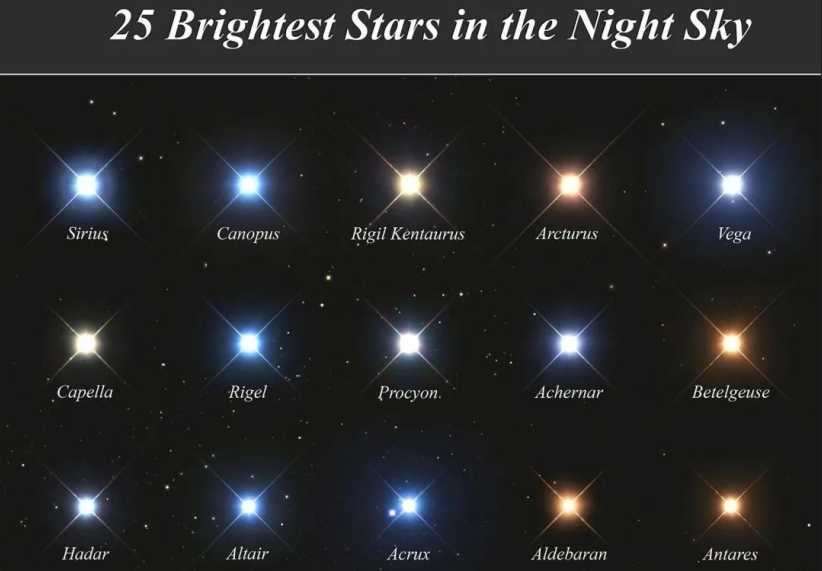
- Sirius (α Canis Majoris): The sky’s brightest star (magnitude -1.46), known as "the Scorcher" in Latin, earned its name for ancient Egyptians who linked its summer rise to the Nile’s flooding. Its Arabic root, al-sīrius, means "glowing."
- Vega (α Lyrae): Shining at magnitude 0.03, this blue-white star took its name from the Arabic waqi', meaning "descending eagle," reflecting its perceived motion in ancient skywatching.
- Antares (α Scorpii): The reddish "Rival of Mars" (Greek anti-Ares), magnitude 0.96, earned its title for matching Mars’ hue. Hindu cultures called it Jyeshtha, the "eldest."
- Capella (α Aurigae): At magnitude 0.08, this yellow giant’s name stems from Latin capella, "she-goat," as it was visualized as a goat in Auriga’s constellation.
The North Star, Polaris (α Ursae Minoris, magnitude 1.97), misses the top 25 due to its moderate brightness, though it’s iconic for guiding navigation. Other stars reveal cross-cultural tales:
- Betelgeuse (α Orionis, magnitude 0.58): From Arabic Yad al-Jauzā, "hand of Orion," this red supergiant dominates Orion’s shoulder.
- Procyon (α Canis Minoris, magnitude 0.34): The "Before the Dog" star (Greek pro-kuōn), preceding Sirius in the night sky.
The IAU’s 1998 Star Name List formalized 1,359 traditional names, ensuring terms like "Sirius" transcend languages while preserving their origins.
These names are more than labels—they’re archaeological records. Sirius was inscribed on Egyptian tomb walls 4,000 years ago; Vega appeared in ancient Chinese star maps as Niú Láng’s lover. By standardizing names, the IAU honors this heritage while enabling global research.
"Each star’s name is a story of how humans across time tried to make sense of the cosmos," says Dr. Eleanor Sanderson of the IAU’s Name Working Group. "From Sirius’ scorching reputation to Vega’s soaring eagle, these monikers remind us that astronomy has always been a shared human journey."
As telescopes reveal deeper skies, the brightest stars remain our oldest cosmic companions—their names whispers from antiquity, now codified for a scientific age.