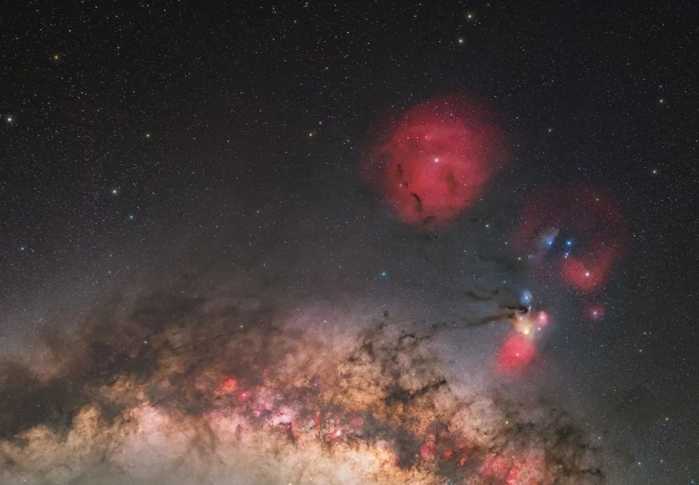
- Adaptation to Darkness: Rod cells in the retina take 20–30 minutes to fully adapt, enabling the eye to detect the Milky Way’s faint stars (down to magnitude 6.5).
- ** Galactic Structure **: The Milky Way’s disk spans ~100,000 light-years, but from Earth, it appears as a 30°-wide band due to our position ~26,000 light-years from the center.
- Nebulae in Context: Rho Ophiuchi (M4) is a star-forming region 400 light-years away, while Zeta Ophiuchi’s red hue comes from ionized hydrogen gas excited by a massive, hot star.
Hawaii’s 4,207-meter volcano is ideal for stargazing:
- Atmospheric Clarity: The summit sits above 40% of Earth’s atmosphere, reducing turbulence and light pollution.
- Telescopic Perspective: The 2.2-meter telescope (part of the Mauna Kea Observatories) captures details invisible to the naked eye, though the Milky Way’s core—packed with 100 billion stars—remains a naked-eye marvel.
- Cultural Significance: For Hawaiians, the Milky Way is "Ka Pālua," a canoe path for ancestral spirits, blending scientific observation with cultural heritage.
- Dark Sky Essentials: Travel to areas with Bortle Class 1–2 skies (e.g., national parks) to see the Milky Way’s full extent.
- Seasonal Timing: In the Northern Hemisphere, the galactic core is visible from late spring to early fall, rising in the southeast after sunset.
- Beyond the Naked Eye: Binoculars reveal star clusters like M8 (the Lagoon Nebula) within the Milky Way, while cameras with wide-angle lenses capture its dusty lanes and nebulae.
As this Hawaiian image demonstrates, the Milky Way is both a scientific marvel and a universal symbol—reminding us that whether from a mountain observatory or a rural field, we all share a seat in the grandstand of the galaxy.